AI that works

IT Modernization at INTER Insurance Group

We worked with INTER to transform a complex legacy IT landscape into a future ready architecture.
#Modernisierung #Datenmigration
A cyclist rides across a modern arch bridge over the sea; behind him, digital circuit board overlays symbolize data migration and digital transformation

Our Impact

  • 400,000 Migrated Health Insurance Contracts Including BRE, Claims, and Tax Data

  • 48% Performance Improvement in Test Scenarios for BRE Migration

  • Reduction from 4 to 1 Java Versions to Establish a Unified Standard

The Challenge

INTER Insurance Group is one of Germany’s established providers of private health, life, and property insurance, with more than 100 years of company history and several hundred thousand policyholders. Like many long established organizations, its IT landscape had evolved over time: legacy host systems, a technologically fragmented environment, and complex data structures.

This resulted in high maintenance effort, complex coordination between systems, and increasing process instability. At the same time, regulatory requirements, data volumes, and pressure for innovation continued to grow. In addition, the merger with Freie Arzt und Medizinkasse (FAMK) required the migration of large volumes of additional portfolio data.

INTER needed to modernize its existing IT landscape without disrupting ongoing operations.

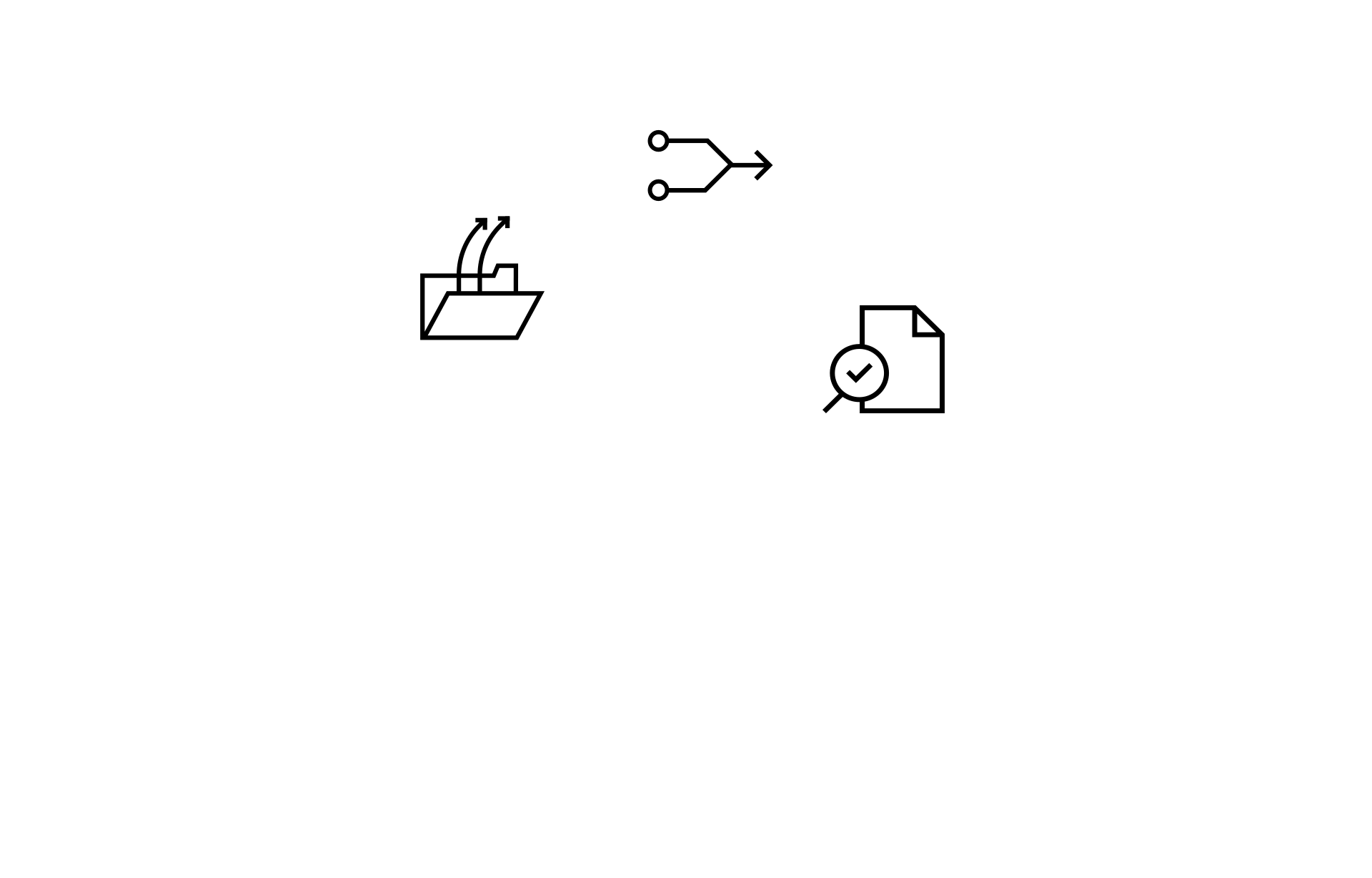
An open hand holds three icons representing the migration of large historical data sets, technological consolidation, and regulatory requirements

Three Core Challenges:

  1. Migration of Large Legacy Data Volumes
    Hundreds of thousands of contribution refund and claims records from the acquired FAMK systems had to be migrated from legacy environments into new target systems, including all calculation and contract logic.

  1. Technology Consolidation
    Applications were running on different Java and Spring framework versions, resulting in divergent runtime environments, inconsistent security standards, and a highly complex testing and operations landscape.

  1. Regulatory Requirements
    Beyond pure data migration, legally relevant reporting logic such as tax related BEG and ELStAM processes also had to be integrated into the new architecture.

The Solution

A key step in INTER’s IT modernization was the standardization of its technology foundation. Applications previously running on different Java and Spring versions were consolidated and migrated to a unified, long term supported technology stack. Heterogeneous versions and individually diverging deployment paths are now a thing of the past. At the same time, existing core systems, including policy management systems and migration tools, were transformed into a modern architecture that enables consistent data flows and improved governance.

This created a consolidated technology foundation that simplifies operations and accelerates further development. Systems, data flows, and technologies are now far more standardized. As a result, new requirements, such as regulatory adjustments or functional enhancements, can be implemented in a much more structured and efficient way.

A process diagram in a browser window shows the high-performance migration of historical data from a host system through BRE transformation and mapping logic into a new inventory system

Migration of Historical Data and Performance Optimization

A major focus was the migration of large historical data volumes. Extensive policy and claims data had to be transferred into the new architecture accurately and with high performance, without disrupting ongoing insurance operations. Migrating BRE data from the host system into the new policy management systems required not only technical transfer rules but also the correct mapping of complex calculation and contract logic. Together with the business departments, we defined clear transformation rules based on real business cases and established a high performance mapping logic. This combination of business expertise and technical excellence enabled a robust, transparent, and repeatable migration process across large scale data volumes.

A process diagram in a browser window shows the workflow from data input through rule-based validation to verified output

Regulatory Integration

Programs for regulatory relevant reporting were integrated into the new architecture at the same time, ensuring secure and transparent processes. Close collaboration was essential throughout the project. Only through a shared understanding of business requirements was it possible to establish rules that ensured both technical consistency and regulatory compliance. The collaboration was defined by continuous exchange, iterative validation, and a shared understanding of the target architecture and target processes.

Browser graphic with three confirmed requirements: flexible, maintainable, and future-proof

IT as the Foundation for Competitiveness

The IT modernization has positioned INTER not only with a modern technology landscape but also with greater organizational and operational stability, supported by an architecture that combines flexibility, maintainability, and future readiness. Building on this newly established architecture, INTER can now realize further projects that consistently advance the digital transformation of its processes, services, and insurance products.


What the Experts Say

  • »With Exxeta, we have a partner that goes far beyond traditional services. Their expertise, commitment to quality, and ability to translate complex business requirements into pragmatic solutions make the difference. The modernization was not an isolated IT project but a strategically designed transformation. Exxeta supported us in consistently modernizing long established structures while always keeping regulatory security and operational stability in focus.«

Get in Touch


More Great Stories